
Sam Flegal

Odin's Secrets

Painting, inking, and drawing PROCESS VIDEOS & ARTICLES if you want to learn more about Sam Flegal’s art, and how he crafts the viking art for Fateful Signs.
Contact
sam@samflegal.com

"Runes shalt thou find, and fateful signs,
That the king of singers colored,
And the mighty gods have made;"
- From the Hávamál, Bellows Translation
Fateful Signs are what Odin saw as he hung from the great World Tree. Fateful Signs are the legends of the Gods and Ancestors carried down to us through the winds of time. Fateful Signs can be sought with runes, carved and made red. Fateful Signs are the words and deeds that honor the Lore of the Norse.
I present you with Fateful Signs.
Fateful Signs is a collection of oil paintings, by Sam Flegal, exploring the various legends and traditions of the ancient Germanic people. The series began out of an interest in Odin and exploded into a spiritual awakening. With each painting a piece of a much greater puzzle is uncovered.
Fateful Signs Creator - Sam Flegal
I first discovered Norse Mythology back in 1999, when I was a Freshman in college. I'd gone to school out-of-state and didn't know many people. This left me with a lot of free time, and I spent it in the school library. At that point in my life, I was questioning religion, so I read about all the world religions. Out of all the myths and legends, the lore of the Norse stuck with me.
Throughout my art education I found ways to bring Norse Mythology into my projects as often as I could. On foggy days I'd even yell "ODIN!" into the mist on campus. Over time I made many friends, and spent less time in the library. Eventually I graduated and became a Graphic Designer. I worked in marketing for many years, but ultimately I found my way back to drawing and painting.
I've been a freelance illustrator since 2009. I've done art for the gaming industry and concept art for movies, but in 2012 I was faced with a client-free month. I didn't know what to do – I hadn't drawn for myself in years! After some soul searching and sketching, I started to work on a painting of a trickster wizard. At first I didn't realize it, but the painting was of Loki. Before the end of the month, I got more client work and never finished the painting; but it got me thinking about the Norse Gods again.
As many artists do, I started to feel a desire to work on more personal paintings. I was reading more about Odin and I felt a connection with the One-Eyed God. Once I finally had the time to devote to personal work, I was inspired to paint Odin holding the head of Mimir, and this became my painting "Odin's Secrets."
I didn't know it then, but this was the beginning of Fateful Signs.
-Sam Flegal (sam@samflegal.com)

Articles


"An ash I know, | Yggdrasil its name,
With water white | is the great tree wet;
Thence come the dews | that fall in the dales,
Green by Urth's well | does it ever grow."
– Voluspa, Verse 19, Bellows Translation


"Many a fearless swordsman
Received the Tears of Freyja
The more the morn when foemen
We murdered; we were present."
– SKÁLDSKAPARMAL, Translated by Arthur Gilchrist Brodeur
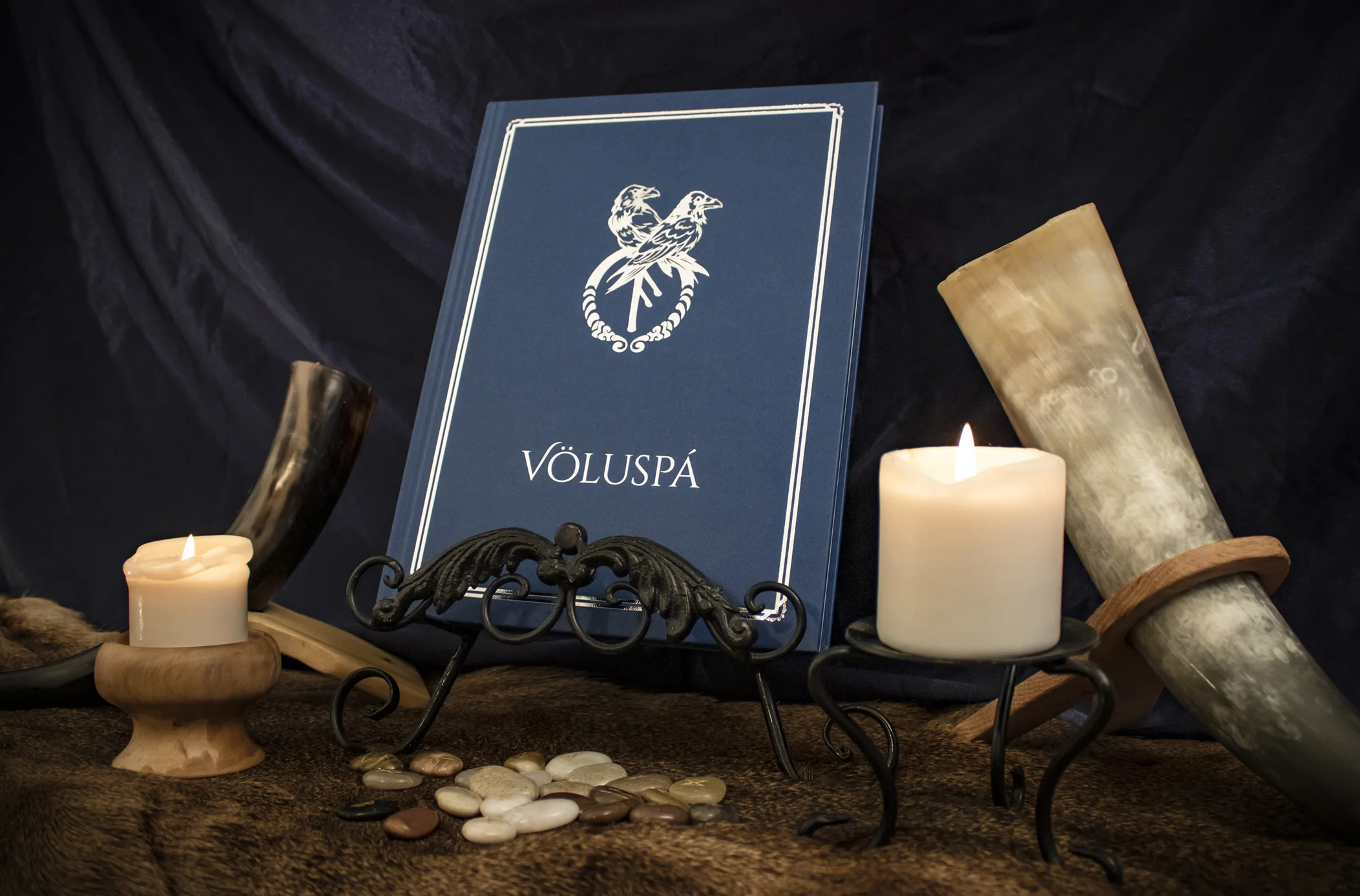
So what is the Voluspa?…
The Voluspa or more accurately Völuspá is the first set of Viking Age poetry in the Poetic Edda. The Völuspá translates to mean the “Prophecy of the Volva” or “Prophecy of the Seer.” A Volva was a wise-woman in old Norse culture. Within the Voluspa poem, Odin journeys to raise the wise-woman from the dead, some say he journeyed to Hel to raise a dead giantess, others suggest the Volva may have been the mother of monsters, Angrboda. Regardless the true identity of the wise-woman is unknown. Once resurrected she first proves her knowledge by explaining the creation myths of the Norse. Then she reveals to Odin secrets that only he is supposed to know, further proving her mastery of lore. Odin then showers her with gifts and asks her to foretell his future. In so doing the wise-woman tells the prophecies of Ragnarok - the twilight of the gods, and the death of Odin himself.

"Thor is the foremost of them, he that is called Thor of the Æsir, or Öku-Thor; he is strongest of all the gods and men... Thor has two he-goats, that are called Tooth-Gnasher and Tooth-Gritter, and a chariot wherein he drives, and the he-goats draw the chariot; therefore is he called Öku-Thor."
– Gylfaginning, Arthur Gilchrist Brodeur Translation

Patreon has become one of my favorite places on the internet. It is a wonderful place to gather with like minded people who share a common interest. In my case that means Norse Mythology, Viking Art, and of course books! If you like those things also take a look at the Fateful Signs Patreon Community.
Patreon has become one of my favorite places on the internet. It is a wonderful place to gather with like minded people who share a common interest. In my case that means Norse Mythology, Viking Art, and of course books! If you like those things also take a look at the Fateful Signs Patreon Community.
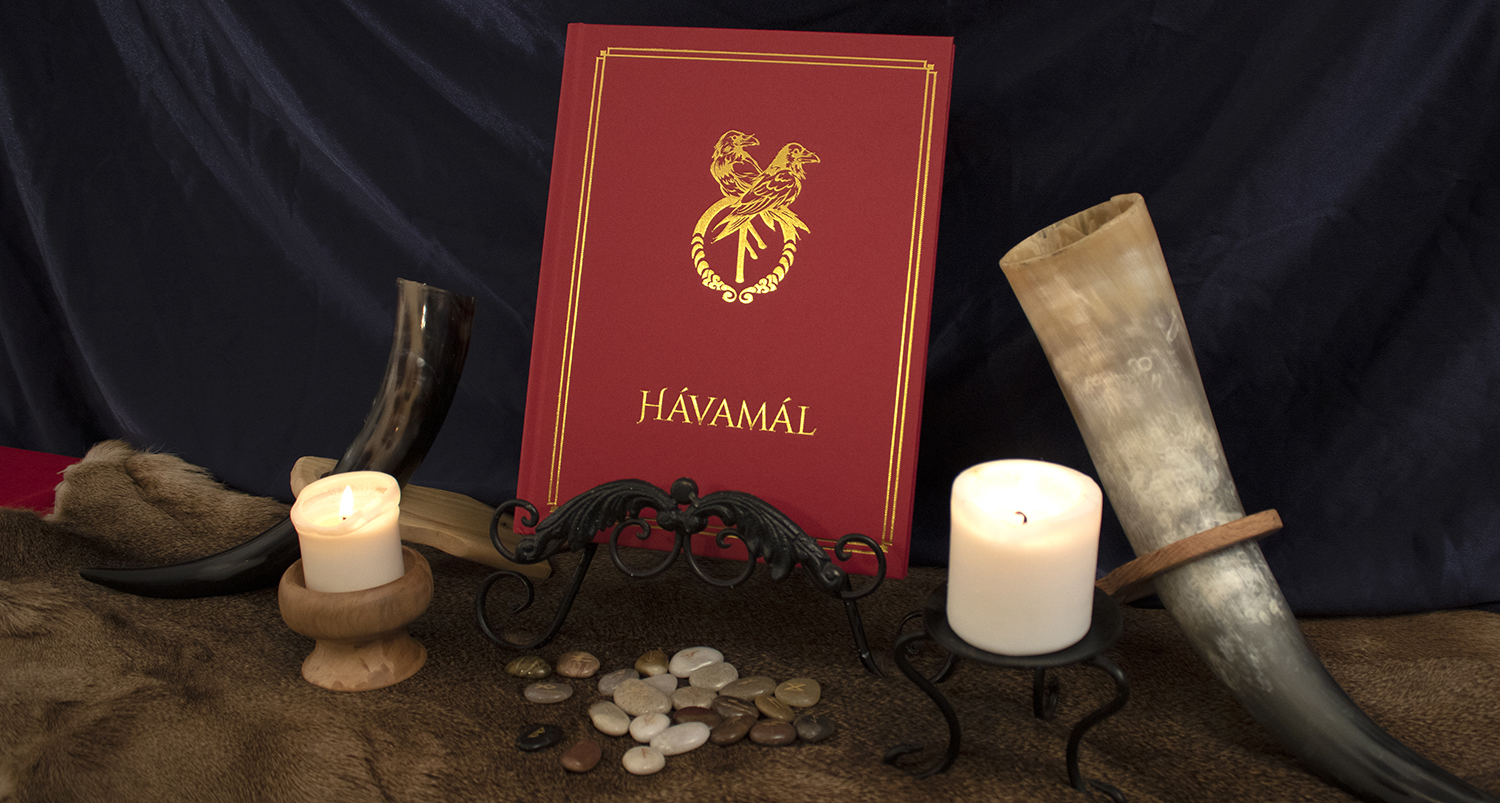
I’ve started a video series for you about the Norse Mythology book, “The Illustrated Hávamál,” where you can learn about all the different ink drawings for the book. You can discover my thoughts on each verse and how I used ink blobs to find the drawings. If you’re interested in Norse Mythology, love Viking art, or have an interest in ancient Viking poetry these are the videos for you!

I just finished reading “The Meadhall” by Stephen Pollington, and it is a wonderfully academic book. While not a Norse Mythology book in the traditional sense, the book is Norse Mythology adjacent. Specifically focusing on Anglo Saxon England from the pagan period to the conversion and slightly beyond. His examination of the mead hall and the central roll it played in the lives of our ancestors is a fascinating read!
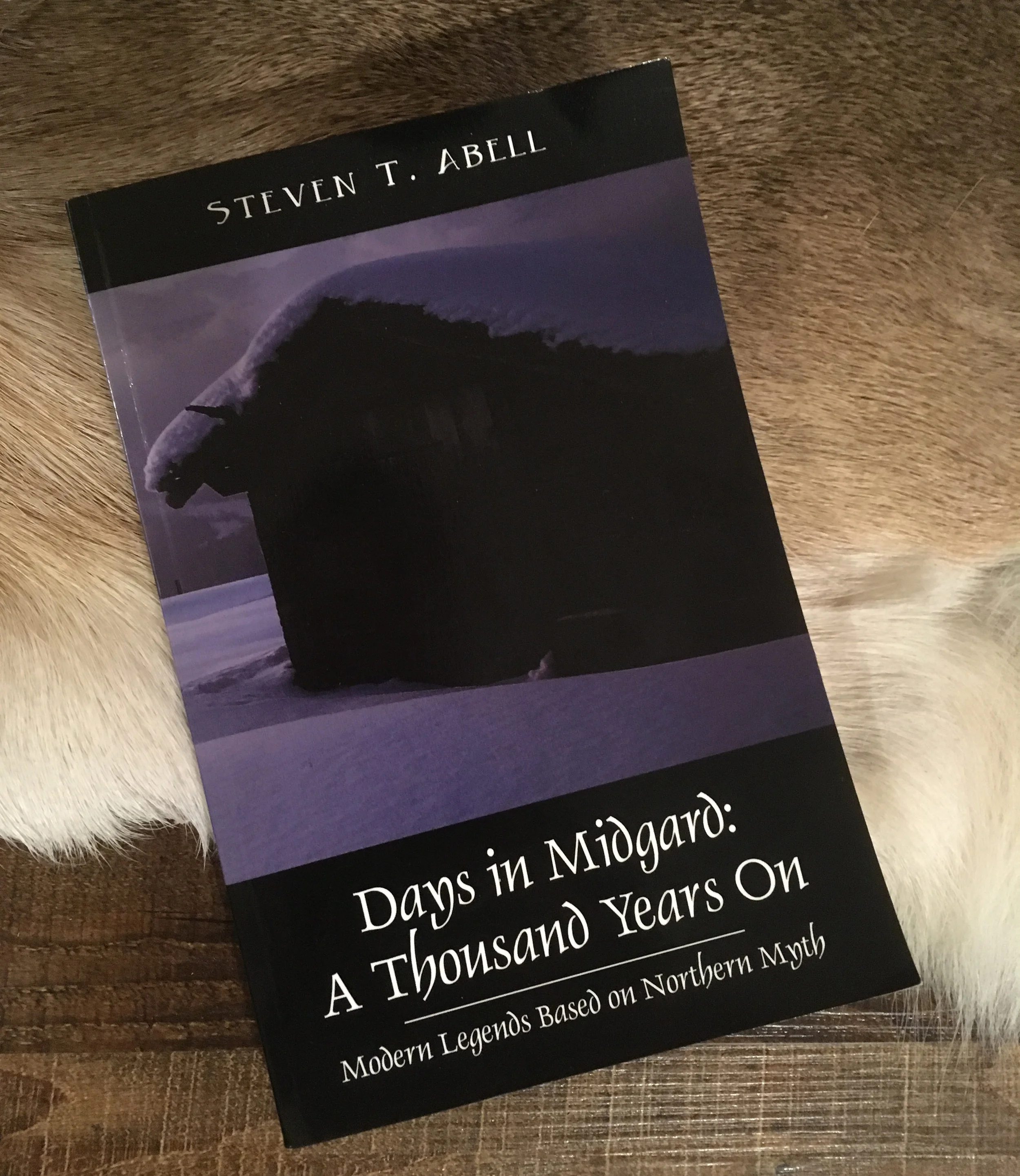
I didn’t include “Days in Midgard” in my original post on Norse Mythology Books because the book does something most other Norse Mythology books doesn’t do… It tells modern stories that features the gods influencing the world right here, right now. It is a genuine attempt to advance the storytelling timeline of Norse Mythology. Just as the title suggests… “A Thousand Years On.”

I recently had an animated gif made of my Viking Art painting, “The Masked One,” and thought this would be a good reason to talk about the painting again!

I’m sure it will surprise no one to learn that one of the influences on my Hoedkin series of “House Spirits” is the book “Gnomes” written by Wil Huygen and illustrated by Rien Poortvliet. Although to be completely accurate it was actually the Nickelodeon TV show “The World of David the Gnome” from when I was a kid that is the strong influence.


Once you have a foundation from reading the Eddas and Sagas, a number of wonderful books are waiting for you to delve deeper into Norse Mythology. More research continues to be done and more books a papers published every year. Truly it is a wonderful time to be alive!
I myself am an avid reader and find regular inspiration for Fateful Signs in the books and lore of past and modern scholars alike. Here is a list of 10 books I recommend for any who seek the wisdom of the Vikings.

All the prints for the Limited Edition Silk Screen of "Runes Shalt You Find" are in, and they look great. Each one has been signed and numbered!

“The Illustrated Havamal” is a real book! I can hold it in my hands, and all the pre-order copies have been mailed out! I’ve made the book available in my store.
----------
WHAT IS THE HAVAMAL?
“The Hávamál” is a collection of ancient Norse wisdom, thought to have been written down in about 1270 CE. The title, Hávamál, translates as “Sayings of Har.” Har is the High One, another name for Odin, hence the ancient text means “Sayings of the High One.” These sayings are a collection of poetry, offering insights and wisdom to help one lead an honorable life.
With the Christianization of the North, scholars took it upon themselves to preserve their ancient culture by writing down these verses. The greatest collection of preserved poetry is “The Poetic Edda,” one section of which is “The Hávamál.”

About a week ago, I got in all the drinking horns from my Norse Mythology book Kickstarter campaign. Each one was hand carved by Brian Marshall from Where the Gods Live. I’ve looked over each of them, taken some photographs and they look absolutely beautiful. I’m so happy with how they turned out! Brian did some amazing work!!!

“Freya’s Due,” is the largest Viking Art oil painting I have ever done. It measures 48" x 29". It was incredibly challenging, but I feel that I have learned so much in its creation for my Norse Mythology series Fateful Signs. I've wanted to do a Freyja painting for awhile. She is the goddess I get asked the most about.

Sometimes things just click with a painting, and "Bragi's Tongue" was one of those. As I worked on my new Viking Art painting for my Norse Mythology series Fateful Signs, things felt effortless. I seemed to know exactly where to put each color and everything just flowed. I finished this Viking art painting in about half the time it usually takes me. Everything just felt right. It was a real joy to work on.

My new Viking Art painting for my Norse Mythology series Fateful Signs, "Vidar, God of Vengeance" was a complicated painting to finish. As you can see from the initial drawing to the final painting I made a lot of changes. I'm very happy with the results, but this painting reminded me of the importance of getting things planned out on the front end of a painting. Making massive changes in oil paint, is not the easy way to go!

My latest Viking Art painting for my Norse Mythology series Fateful Signs, "The King's New Crown" took a lot of twists and turns. It started as one thing and became something else as I worked on it. It's usually best to follow the trail inspiration leads you down, but it can be a windy path.

In English speaking countries we get most of our days of the week from Norse Mythology. This is because English traces back to Old English, and ultimately Old Norse. This is the reason English is a “Germanic” language.